

Cold glue or hot glue: which is better for dent pulling?
Neither is better across the board – it depends on the dent. On soft, shallow dents such as hail damage, cold glue is in our experience at least two to three times faster. Hot glue with tabs is stronger on sharp dents, creases and difficult spots. That is why most dent technicians use both.
In short
- Cold glue: soft dents, hail, roofs and bonnets – on suitable dents at least two to three times faster.
- Hot glue + tabs: sharp dents, creases, difficult spots.
- Cold glue: no waiting time, no melting.
- Cold glue tabs made of aluminium last; plastic hot glue tabs wear out.
- Not a replacement but a complement – most dent technicians use both techniques.
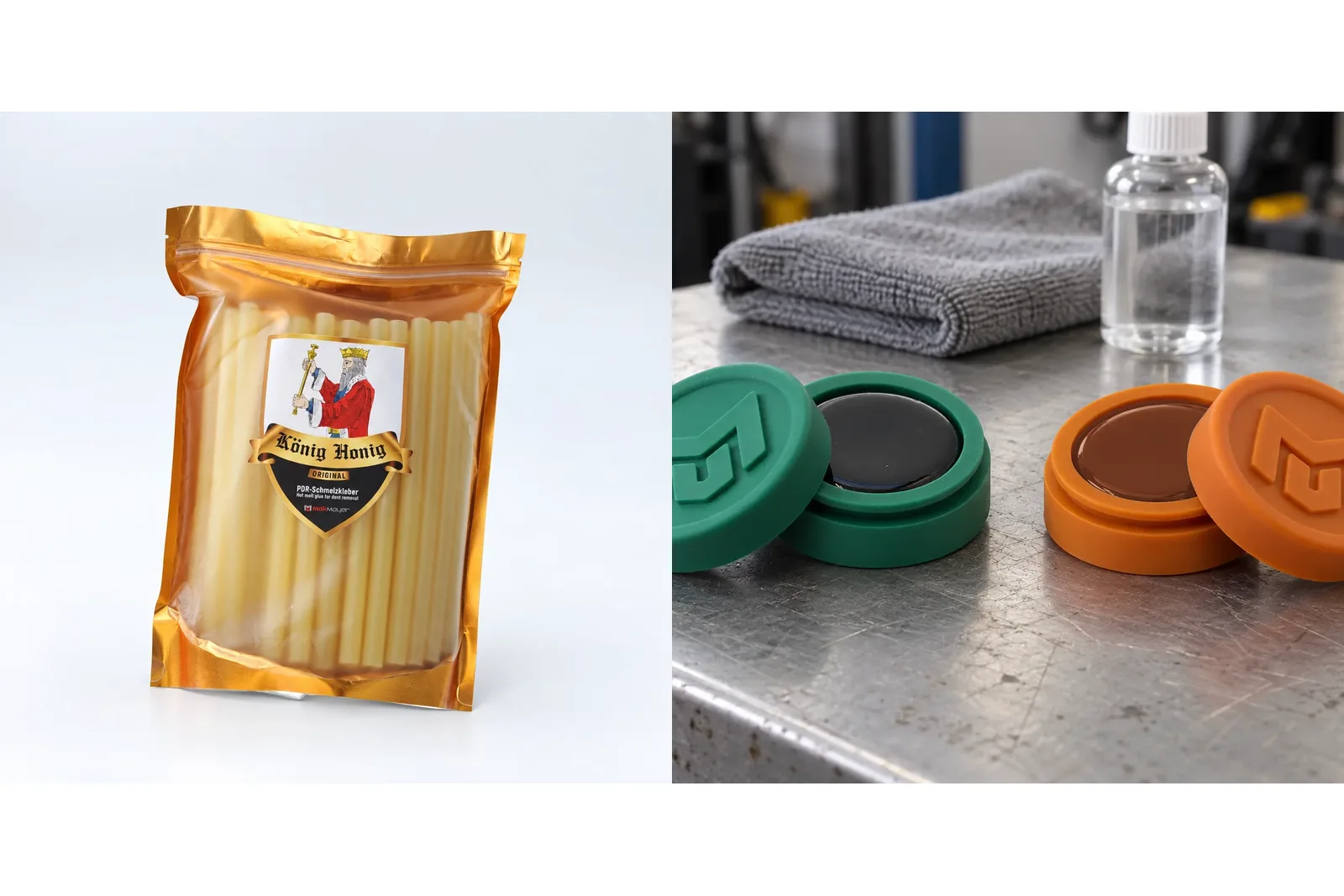
The comparison at a glance
| Cold glue | Hot glue with tabs | |
|---|---|---|
| Ideal for | soft, shallow dents, e.g. hail damage; especially roofs and bonnets | sharp dents, creases, difficult spots |
| Process | thin layer on the tab, place, pull right away | melt glue in the gun, apply to tab, place, let it set, pull |
| Speed | on suitable dents, in our experience at least 2–3× faster | slower due to melting and setting |
| Waiting time | none | e.g. König Honig: approx. 5–6 s (slide hammer), 10–12 s (mini lifter) |
| Temperature | grade by temperature: Summer from 17 °C, Winter 0–18 °C | depends on the glue; König Honig at almost all temperatures |
| Tab | aluminium, durable | usually plastic, wears out |
| Tools | slide hammer, cold glue tabs, cold glue | glue gun, tabs, hot glue, slide hammer or mini lifter |
Where does the speed advantage of cold glue come from?
With hot glue, every pull involves: melting the glue, applying it to the tab, placing the tab, waiting until the glue has set. With cold glue, a layer is already on the tab – place it, briefly work it onto the panel, pull. One layer lasts a long time; some technicians work with the same one for over a month. On dents that suit cold glue, this is in our experience at least two to three times faster.
When hot glue is the better choice
On sharp dents, creases and difficult spots, cold glue often does not pull well enough. Hot glue with tabs is then the better choice. A good dent technician decides on every dent which tool fits.
Consumption and wear
- Cold glue: one 8 g tin lasts at least 1–2 years of active use. The aluminium tabs last.
- Hot glue: glue is melted and applied anew for every pull. Plastic tabs are reusable until they break and need to be replaced.
Best of all: have both
Cold glue and hot glue do not replace each other, they complement each other. Makmayer offers both: Summer and Winter cold glue with aluminium tabs, and König Honig hot glue with PrismTabs.
Frequently asked questions
Is cold glue better than hot glue?
Not across the board. On soft dents such as hail damage, cold glue is in our experience at least two to three times faster; on sharp dents and creases, hot glue with tabs is often better.
Does cold glue replace hot glue?
No. They are two techniques that complement each other. Most dent technicians use both.
Does cold glue need to cure?
No. Place the tab, briefly work it onto the panel and pull right away.
Which glue is better for hail damage?
On soft dents such as hail damage, especially on roofs and bonnets, usually cold glue – because of the speed advantage. Sharp single dents and creases are often pulled better with hot glue.
Want to try both techniques?
The cold glue trial set to get started with cold glue, König Honig and PrismTabs for hot glue.